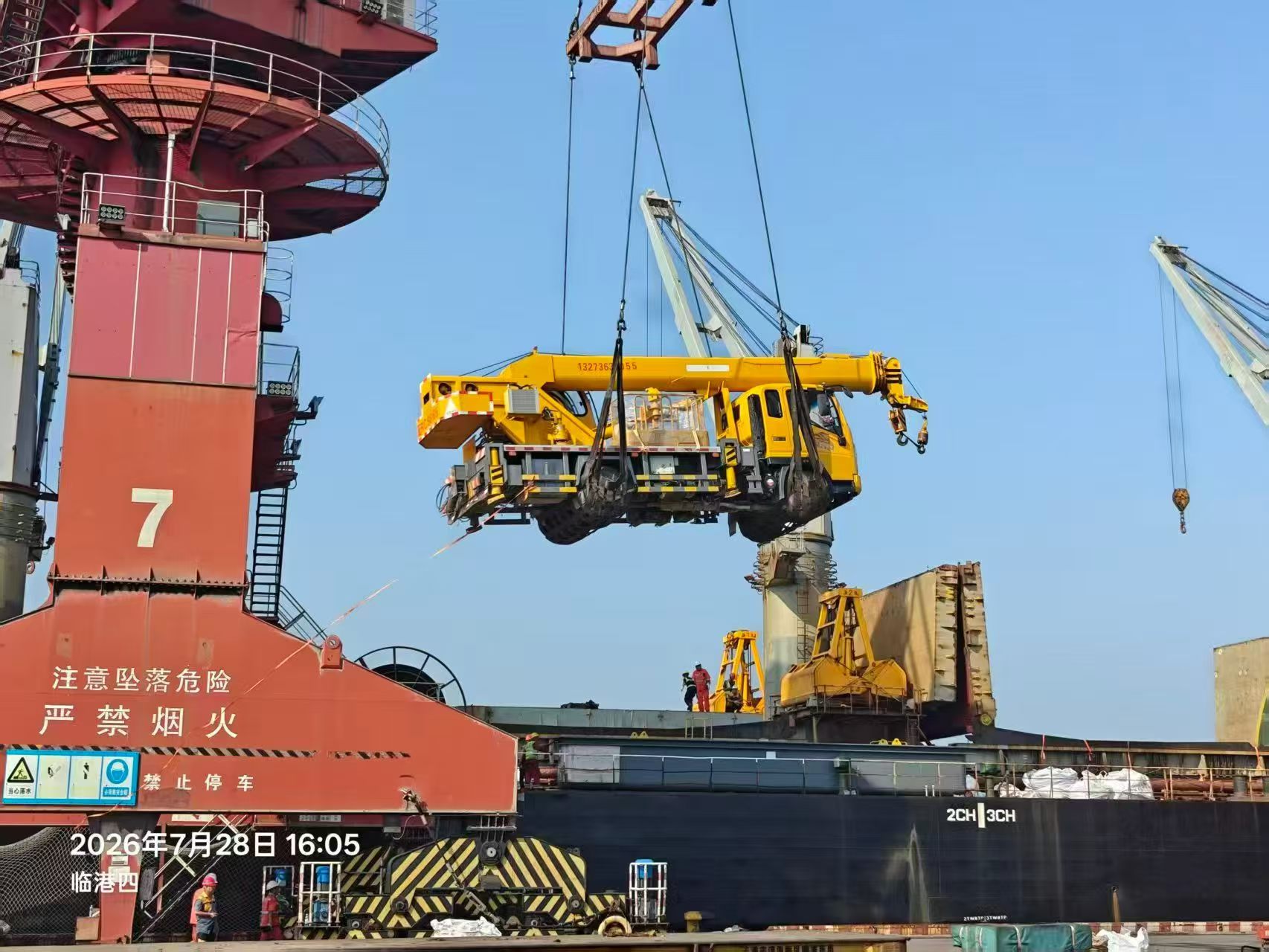
The search for mobile crane vs crawler crane usually starts with tonnage, but tonnage alone does not select a crane. A machine rated at 80 tons cannot lift 80 tons at every radius, boom length, or setup. The useful question is: which crane type can perform the required lift in the actual site configuration?
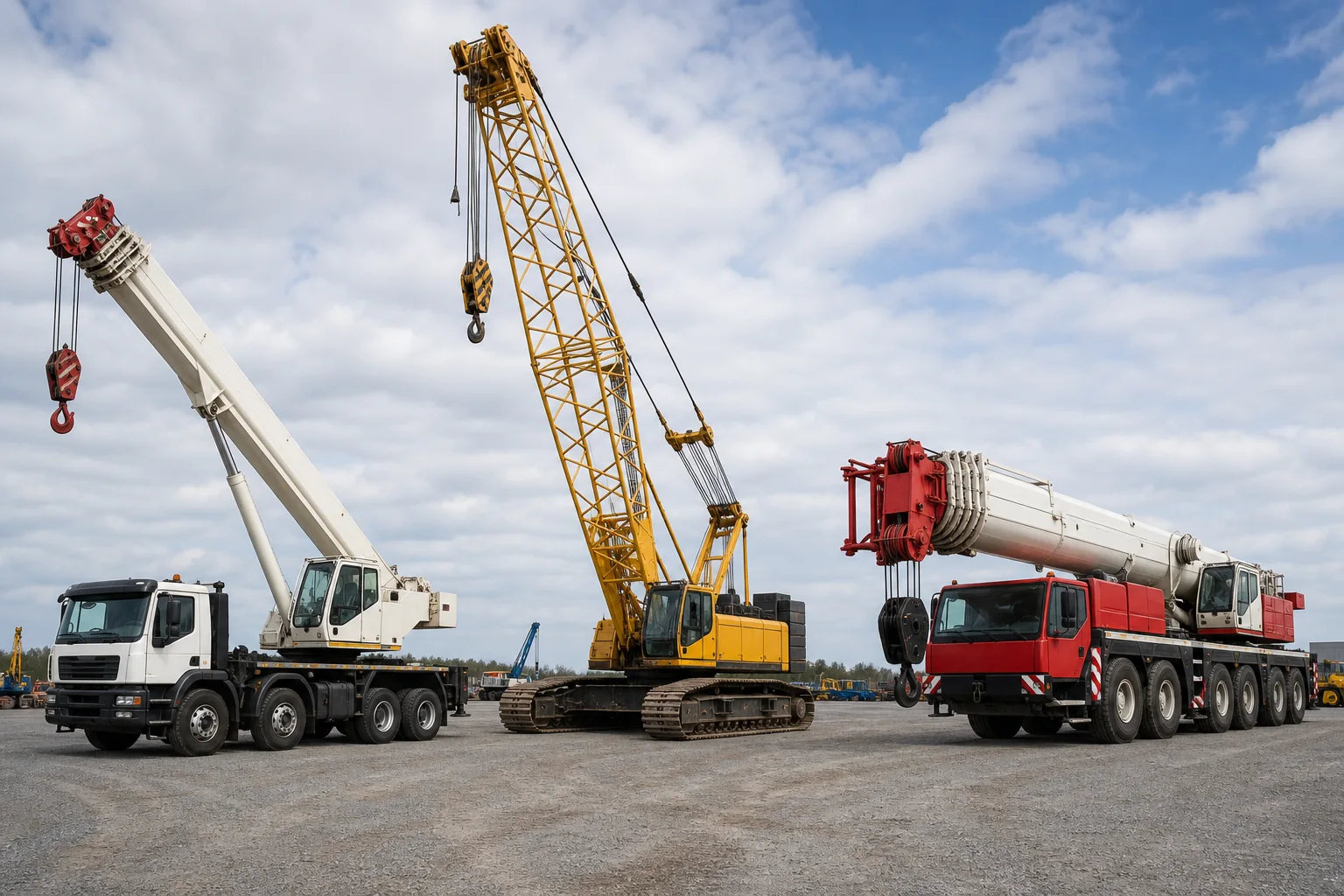
This guide compares the three categories represented in our current inventory: truck cranes, crawler cranes, and all-terrain cranes. It is written for buyers comparing used machines, not as a substitute for an engineered lift plan.
Mobile Crane vs Crawler Crane: Quick Comparison
| Decision factor | Truck crane | Crawler crane | All-terrain crane |
|---|---|---|---|
| Travel between sites | Wheeled carrier; road use depends on local rules | Normally transported in components between distant sites | Purpose-built multi-axle carrier; road use depends on local rules |
| Lifting support | Outriggers on prepared bearing areas | Tracks on prepared and verified ground | Outriggers on prepared bearing areas |
| Typical job pattern | Repeated short- or medium-duration jobs | Longer-duration work and heavy project lifts | Projects requiring both road mobility and difficult site access |
| Setup | Deploy outriggers and configure boom, counterweight, and safety systems | Transport, assembly, reeving, counterweight, and commissioning may be required | Deploy outriggers and configure boom, counterweight, and safety systems |
| Transport planning | Dimensions, axle loads, permits, and route restrictions | Number and weight of transport components, assembly space, and assist crane | Dimensions, axle loads, permits, and route restrictions |
| Used-machine focus | Carrier, outriggers, boom, hydraulics, brakes, tires, and controls | Track gear, carbody, boom sections, pins, wire rope, hydraulics, and assembly completeness | Axles, steering modes, suspension, driveline, outriggers, boom, and electronics |
There is no universal winner. A truck crane may be the most practical machine for frequent relocation, while a crawler crane may better suit a long project where transport and assembly happen once. An all-terrain crane makes sense when both road movement and job-site access matter enough to justify its more complex carrier.
Mobile or Truck Crane
On this website, mobile cranes are the combined commercial group of truck cranes and all-terrain cranes. The individual inventory categories remain separate because their carriers, operating costs, transport requirements, and buyer checks differ.
A truck crane uses a wheeled carrier and telescopic boom. It lifts on outriggers rather than on its tires. Buyers commonly choose this category when the machine must relocate regularly and the sites offer suitable access and prepared outrigger bearing areas.
Before buying, verify:
- the exact carrier and crane model, because similar model names can have different axle or boom configurations;
- road-registration and axle-load requirements in the destination country;
- outrigger condition, full extension, controls, floats, and available load-chart configurations;
- boom section alignment, wear pads, pins, sheaves, wire rope, hook block, and hydraulic cylinders;
- carrier brakes, steering, driveline, tires, instruments, and safety devices;
- which counterweights, jib sections, manuals, and accessories are included in the sale.
Browse current used truck cranes
Crawler Crane
A crawler crane uses tracked undercarriages and normally a lattice boom. Its tracks spread the machine load over a larger contact area, but that does not mean it can work on unverified soft ground. Ground-bearing capacity, level, drainage, underground services, working platforms, and manufacturer limits still require engineering review.
Crawler cranes are normally considered when a project involves longer deployment, assembly space, heavy components, or configurations not practical for a wheeled crane. Their purchase decision must include logistics: the crane may require several transport loads, an assist crane, assembly labor, and enough space to build the boom.
For a used crawler crane, confirm:
- the component list against the intended boom, jib, counterweight, and hook-block configuration;
- track shoes, rollers, idlers, sprockets, travel drives, carbody connections, and hydraulic leaks;
- boom chords, lacings, welds, connector pins, pendants, sheaves, and wire ropes;
- load-moment, anti-two-block, limit, alarm, and display functions applicable to the model;
- transport dimensions and weights for every major component;
- access to model-specific assembly instructions, load charts, parts, and qualified service support.
Browse current used crawler cranes
All-Terrain Crane
An all-terrain crane is a mobile crane with a purpose-built multi-axle carrier. It is designed to combine road travel with better site mobility than a conventional truck crane. It still lifts on outriggers and still requires verified ground support.
The carrier is more complex than a standard truck-crane chassis. A pre-purchase inspection should therefore include axle steering modes, suspension, driveline, braking systems, tires, carrier electronics, outriggers, and the crane upper. Buyers should also confirm axle-load rules, permitted travel configuration, and whether counterweights must move separately in the destination market.
Browse current used all-terrain cranes
How to Read a Crane Lifting Capacity Chart
A crane lifting capacity chart, or load chart, states the manufacturer’s rated capacities for defined configurations. It must belong to the exact model and, where applicable, the correct serial-number range and regulatory version.
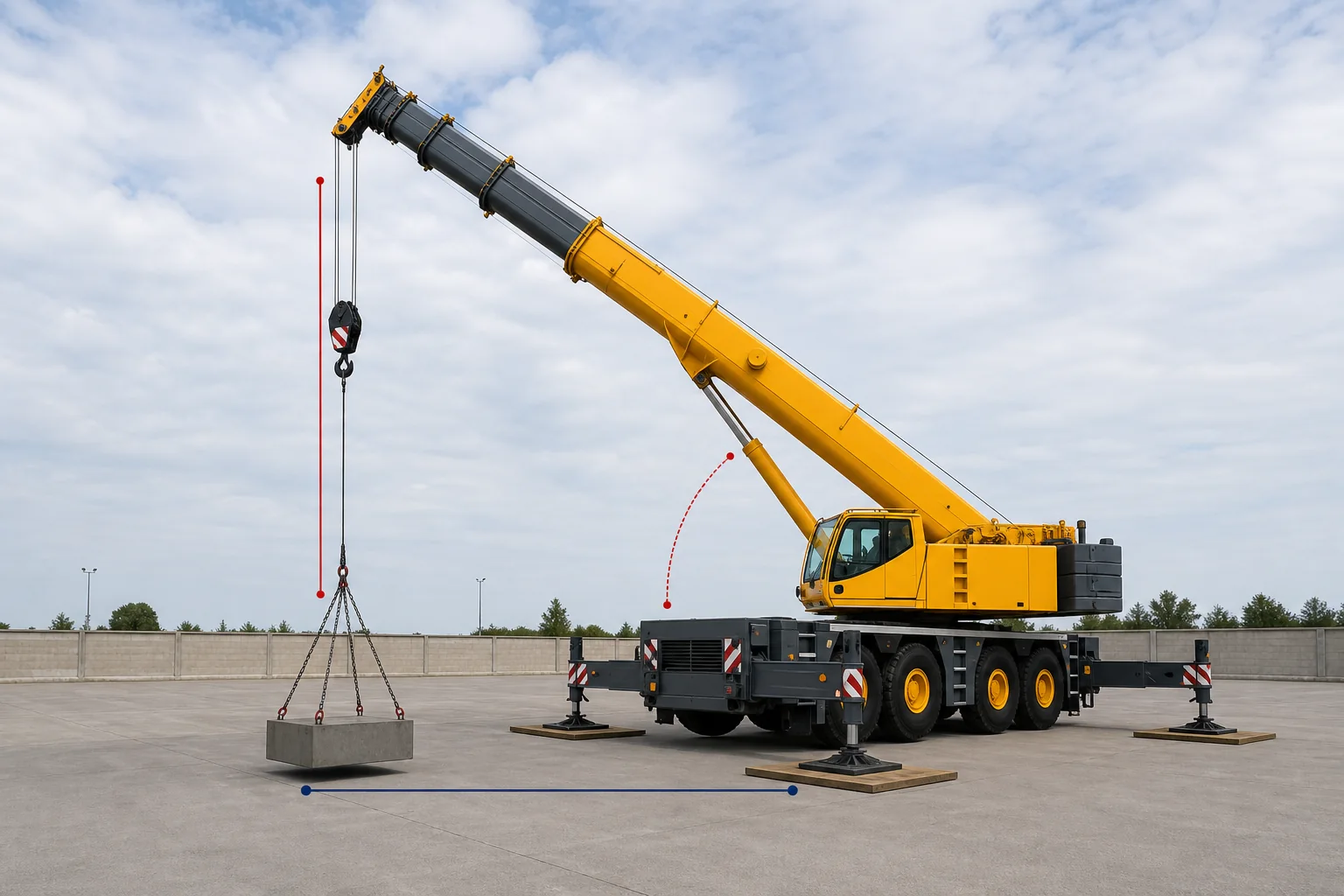
Check these inputs before reading a capacity:
- Working radius: horizontal distance defined by the manufacturer, normally measured from the crane’s center of rotation to the load line.
- Boom length and angle: the same crane has different capacities at different telescopic or lattice-boom configurations.
- Outrigger or track configuration: full, intermediate, and restricted outrigger positions can have different charts; crawler capacities may depend on track position and lifting quadrant.
- Counterweight: use only the chart matching the counterweight actually installed.
- Jib and attachments: installed or stowed attachments may change allowable capacity.
- Lifting area: some charts distinguish over-front, over-side, over-rear, or 360-degree operation.
- Deductible load: hook block, slings, shackles, spreader beams, and other rigging contribute to the load on the crane.
Never estimate capacity by multiplying load weight and radius or by applying a generic safety percentage. Those shortcuts do not account for structural, stability, configuration, or manufacturer limits. Use the exact load chart and have the lift reviewed by a qualified person under the rules applicable at the job site.
What Size Crane Do I Need?
Prepare a lift requirement before comparing inventory:
| Required input | What to record |
|---|---|
| Load | Verified weight, center of gravity, lifting points, dimensions, and wind area |
| Radius | Required working radius throughout the lift, including pick and set positions |
| Height | Hook height, obstructions, required clearance, and boom or jib geometry |
| Site | Access width, turning space, slope, overhead hazards, underground services, and ground-bearing capacity |
| Configuration | Outrigger or track position, counterweight, boom, jib, hook block, reeving, and lifting quadrant |
| Logistics | Road limits, transport pieces, assembly area, assist crane, permits, and port handling |
Then compare candidate models using their official load charts. The smallest acceptable crane is not necessarily the best purchase: availability of the required configuration, condition, parts support, transport cost, and the range of future jobs also matter. Conversely, buying a much larger machine can increase transport, ground preparation, fuel, maintenance, and permitting requirements.
Kaihui Cranes can help identify inventory that matches a stated capacity range, but the buyer’s lift planner or other qualified professional remains responsible for approving the actual lift.
Used-Crane Checks That Affect the Decision
Once the crane type and required chart capacity are known, compare machines on evidence rather than model badges alone:
- nameplate, serial number, stated year, operating hours, and available records;
- included boom, jib, counterweight, hook blocks, rigging, manuals, and loose components;
- structural condition, previous repairs, corrosion, leaks, wear, alarms, and active fault codes;
- functional-test scope and whether a suitable test load and site are available;
- independent inspection requirements such as BV or SGS;
- packed dimensions, component weights, export documents, and destination import requirements.
Use our used crane inspection checklist and safe buying guide before agreeing the contract, inspection scope, and payment schedule.
Compare Current Inventory
Start with the category matching the job pattern, then compare individual model load charts and condition evidence:
- Mobile cranes for sale — current truck and all-terrain inventory.
- Truck cranes for sale — wheeled commercial-chassis cranes.
- Crawler cranes for sale — tracked lattice-boom machines.
- All-terrain cranes for sale — purpose-built multi-axle mobile cranes.
For a useful recommendation, send the load, radius, height, site conditions, destination country, and preferred brand or budget range.